Description
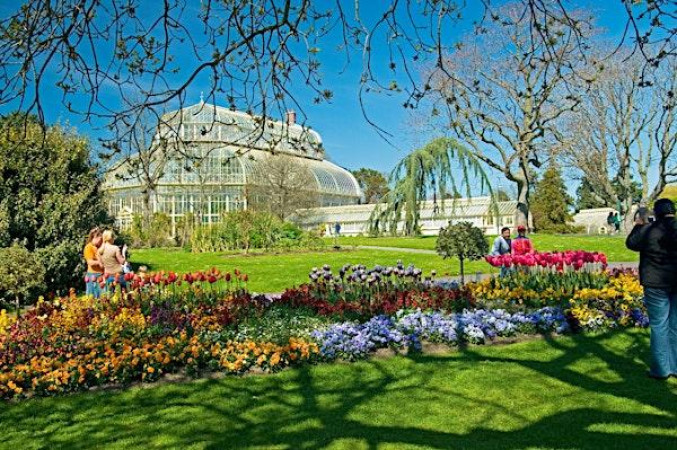
The National Botanic Gardens in Glasnevin, Dublin, is a beautiful and peaceful oasis just a short distance from the city centre. Home to over 15,000 plant species from around the world, it combines stunning landscapes with scientific importance. It’s a perfect destination for nature lovers, families and anyone looking for a relaxing day out.
Visitors can explore a wide variety of attractions including the famous Victorian glasshouses such as the Great Palm House, Curvilinear Range, Orchid House and Cactus & Succulent House. The gardens also feature themed areas like the Rose Garden, Rockery, Arboretum and Sensory Garden, along with historic features like sundials, sculptures and a bandstand. Guided tours, seasonal exhibitions and educational workshops add to the experience, while cafés and walking paths make it easy to enjoy the surroundings.
Entry to the gardens is completely free, making it an excellent value attraction. Parking is available with charges starting at €1 per hour for the first two hours and €2 per hour thereafter.
With its mix of natural beauty, historic glasshouses and educational experiences, the National Botanic Gardens offers something for everyone. Whether you’re exploring exotic plants, enjoying a peaceful walk or learning about conservation, it’s a memorable and enriching place to visit.
Features
- Free
- Host birthday parties: No
Features
Glasshouses
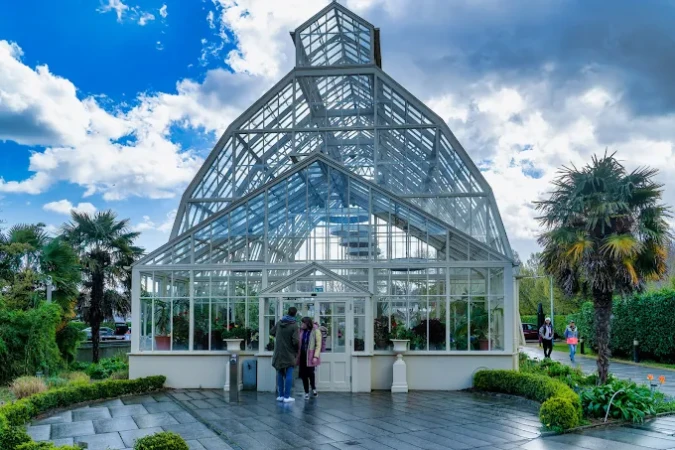
The Turner Curvilinear Range and the Great Palm House are both recipients of the Europa Nostra Award for excellence in conservation architecture. The glasshouses are open every day throughout the year except for Christmas Day, and are completely free to enter and explore. Interpretative guided tours are available Monday to Saturday for a small fee, and are free on Sundays. Click here for information on opening hours, and here for information about tours.
- The Teak House: The Teak House and the Orchid Fair. Courtesy of Poilin Nic Geidigh for DITSU. Bonsai Exhibition in the Teak House.
- The Alpine House: A constantly changing display of Alpine plants provides interest throughout the years in the Alpine House and Alpine Yard.
- The Cactus and Succulent House: This glasshouse has also been known as the Flowering House, but is currently holding the Cactus and Succulent collection while their original house is undergoing restoration works.
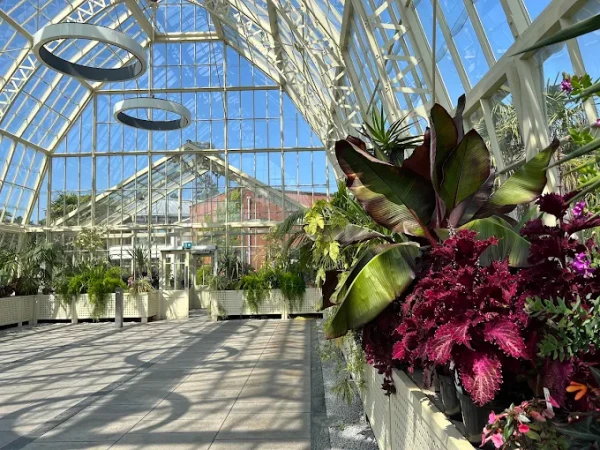
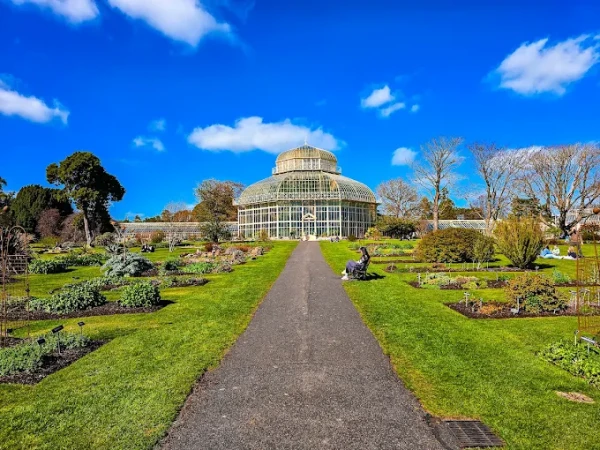
- The Great Palm House: Built in 1883 when the previous glasshouse was damaged in a storm, the ironwork was fabricated in Glasgow, Scotland and transported to Glasnevin. A faithful restoration by the Office of Public Works was begun in 2002. The restored house was opened by an Taoiseach in 2004.
- The Orchid House: Orchids have a special place at Glasnevin. It was here, in the 1840s that orchids were first grown to flowering stage from seed by the curator, David Moore. The orchid house was restored along with the great Palm House in 2004.
- The Curvilinear Range: This beautiful long, low range of glasshouses is built of iron and has a distinctive, curved roof. This style and method of construction was promoted by the celebrated Dublin iron-master Richard Turner; he was instrumental in having this range erected, and was largely responsible for its design.
- The Victoria Waterlily House: The Victoria waterlily house was designed by Duncan Ferguson, and built in 1854. About half the cost (£550) was raised by charging admission to a horticultural fete, which was held at the Gardens on the 24th June 1853. The house was was one of many built across Europe to house the botanical sensation of the time – Victoria amazonica, the Amazon waterlily.
- The National Herbarium: The National Herbarium at Glasnevin contains a collection of more than half a million dried and documented plant specimens from Ireland and the rest of the world. This collection is vital to the study of plant distribution, diseases, DNA, climate change, and much more. Also housed in here is the Economic Botany Collection, which is made up of a substantial collection of plant specimens as well as plant-derived products and artifacts.
- The Curvilinear Range: Arguably the most splendid building in the Gardens, the stunning Curvilinear Range is a unique example of a faithfully restored Victorian era wrought iron glasshouse. Designed by native Dubliner Richard Turner, it was completed in stages between 1843 and 1869. Turner was also responsible for designing the Palm Houses at Kew Gardens and Belfast but both of these have been restored with the use of steel.
- Great Palm House: Step up into the heights of Ireland’s only tropical rainforest! Have you ever looked up to the walkway in the Palm House and wished to access it? Now is your chance. For health and safety reasons, usually only the gardeners and maintenance staff are allowed up there. The gardeners use it to tend to plants – pruning the leaves and even cutting down plants that are getting too tall, such as the giant bamboo.
Garden Features
Here we have selected a few highlights, but you will discover many more on your visit. The Gardens are open every day throughout the year except for Christmas Day, and are completely free to enter and explore. Interpretative guided tours are available Monday to Saturday for a small fee, and are free on Sundays.
- The Sundials: There are two sundials in the National Botanic Gardens, Glasnevin. One in front of the Palm House is the more familiar horizontal dial. This one was made in the mid eighteenth century by Lynch of 26 Capel Street, Dublin. It is one of the few dials in Ireland with a time-scale graduated in single minutes. It also features the names of other cities from Bombay to Rio de Janeiro, indicating the moment of solar midday for them. On the right, the cities of Madrid, London, Paris, and Rotterdam can be seen adjacent to the gnomon.
- The Bandstand: Built in 1894, the bandstand is in fact no more than a shelter which would never have accommodated a band. Until the 1860s the conservatories were kept locked to the public, and by 1877 there were no more than three dozen seats in the entire garden. This building thus supplied much needed shelter and seating when it was built.
- The Chaintent: The chaintent is a remarkable circular pergola erected some time after 1834 by the then head gardener Ninian Niven. Until 1870 it was centred by a weeping ash tree, from which the chains descended, but this was then replaced by an iron pole. Today the pergola supports a number of venerable Wisteria plants.
- Socrates: Records suggest that the statue of Socrates arrived in the gardens in 1959 from Iveagh House. The Annual Report of the Minister for Agriculture 1959-60 states that Two marble figures representing Mercy and Socrates which had previously been in Iveagh House, St Stephens Green, Dublin, were erected in the Gardens and were much admired by visitors.
- Craobh: Craobh, carved by Gerard Cox, was commissioned by the Royal Dublin Society, and presented by the President, Mr Sean Tinney, on the 11th July 1995 to commemorate the bicentenary of the National Botanic Gardens. The Irish word ‘craobh’ translates as the branch or bough of a tree. Craobh is a large wooden sculpture, and was created by carving straight into the trunk of a Hungarian oak tree.
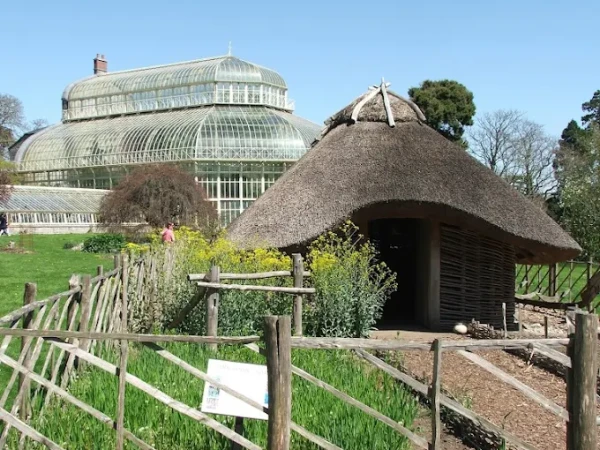
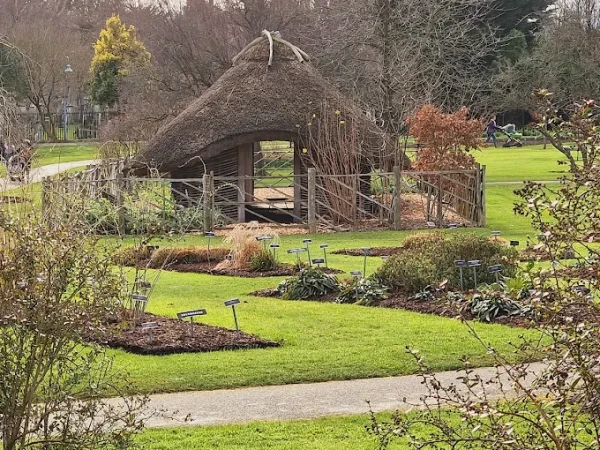
- The Viking House: The Viking House came about as a project to mark the millennium of the Battle of Clontarf in 1014. The enthusiastic support of Dublin City Council, the National Museum of Ireland and the School of Archaeology, University College Dublin is gratefully acknowledged. We received generous financial assistance from the Irish Museums Trust and Dublin City Council.
Our fine plant collections hold over 15,000 plant species and cultivars from a variety of habitats from all around the world. Within the living collections at the National Botanic Gardens we have over 300 endangered species from around the world, and six species already extinct in the wild.
- Wild Ireland
- The Family Beds
- The Sensory Garden
- The Rockery
- The Herbaceous Border
- The Carpet Beds
- The Rose Garden
- The Yew Walk/ Addison’s Walk
- The Arboretum
- The Fruit and Vegetable Garden













 0.00 miles