Penrith Castle

Description

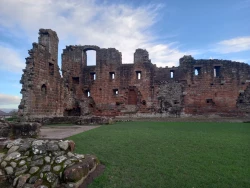
Penrith Castle was begun at the end of the 14th century by Ralph Neville, who played a key role in defending this area against the Scots. It was later transformed into a luxurious residence by Richard, Duke of Gloucester, who became Richard III. Surviving to their full height, the castle walls stand in a public park.

Penrith Castle was built at the end of the 14th century by Ralph Neville, 1st Earl of Westmorland. He and his successors played important roles in the defence of the Scottish border in the late 14th and 15th centuries, and the castle symbolised their power in the area. 

Free Entry. If you are looking for Best place for day out with kids and families then this is the perfect destination offering fun, adventure, and unforgettable memories for everyone.

Features

  • Free
  • Host birthday parties: No

Features

  • History of Penrith Castle: Penrith Castle was built at the end of the 14th century by Ralph Neville, 1st Earl of Westmorland. He and his successors played important roles in the defence of the Scottish border in the late 14th and 15th centuries, and the castle symbolised their power in the area.
  • After the death of Ralph’s grandson Richard Neville (Warwick ‘the Kingmaker’) in 1471, the castle was granted to Richard, Duke of Gloucester, later Richard III. He transformed it into a luxurious residence and lived there for periods between 1471 and 1483.
  • Penrith and the Nevilles: Ralph Neville (about 1364–1425) was granted the manor of Penrith in 1396 and probably began building the castle soon afterwards. It is first mentioned in documents in 1412.
  • Richard, Duke of Gloucester: The 5th Earl’s son, Richard Neville (‘the Kingmaker’), 16th Earl of Warwick and 6th Earl of Salisbury, held the castle until he was killed at the Battle of Barnet in 1471. Edward IV then granted it to his younger brother, Richard, Duke of Gloucester (1452–85), who sometime between 1472 and 1474 married Warwick’s daughter, Anne Neville. Gloucester later became King Richard III (reigned 1483–5).
  • Sixteenth-century changes: After Richard became king, the castle remained Crown property, but it was not used again as a permanent residence. Late 16th-century accounts and surveys record details about the castle which all testify to its general decline. However, recent research has found that five months of building works were recorded in 1577, suggesting there was a final phase of construction and occupation at the site.
  • Railways, antiquarians and archaeologists: Passing references in the 18th century suggest the castle was appreciated for its romantic state of decay. In 1825 one source lamented that the site was set about with pigsties and animals, suggesting it was being used as a farm in what was then still a rural area on the edge of Penrith town.

Facilities

  • Parking: Parking is available around the town, with a few spaces at the park entrance.
  • Food & Drinks: There is a café within the park (not managed by English Heritage), and plenty of shops and places in Penrith, along with public toilets.

Price

Price: Free

Birthday Parties

Offer Birthday Parties: No

  • Open daily.
  • Open in line with the surrounding parkland. 7.30am-9pm from 31 March to September, and 7.30am-4.30pm from October to 30 March.

Address: Castle Terrace, Penrith CA11 7EA, UK

Post Code: CA11 7EA

Council: Westmorland and Furn

County: Cumbria

  • Road Access: Opposite Penrith railway station.
  • Bus Access: From surrounding areas.
  • Train Access: Penrith (adjacent)
  • Bicycle Access: Find this site on The National Cycle Network.
  • Parking: Parking is available around the town, with a few spaces at the park entrance.

0.00

0 Reviews

Rating breakdown

5
80% Complete (danger)
0
4
80% Complete (danger)
0
3
80% Complete (danger)
0
2
80% Complete (danger)
0
1
80% Complete (danger)
0

More Day Outs in Westmorland & Furness

Get the best blog stories into your inbox!