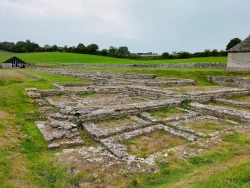
North Leigh Roman Villa

North Leigh Roman Villa, A4095, North Leigh, Witney, Oxfordshire OX29 6PZ, UK
1-99 Years

Description

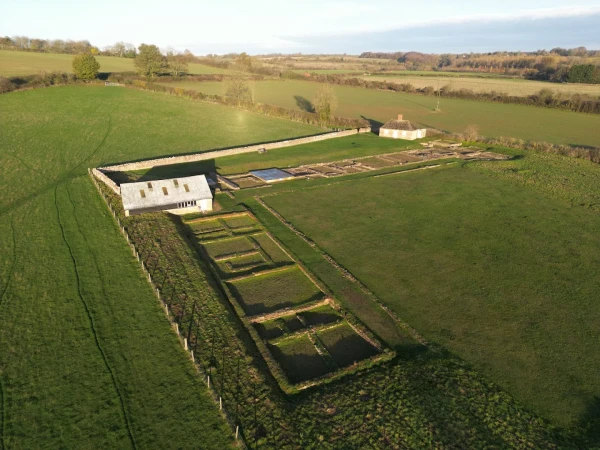
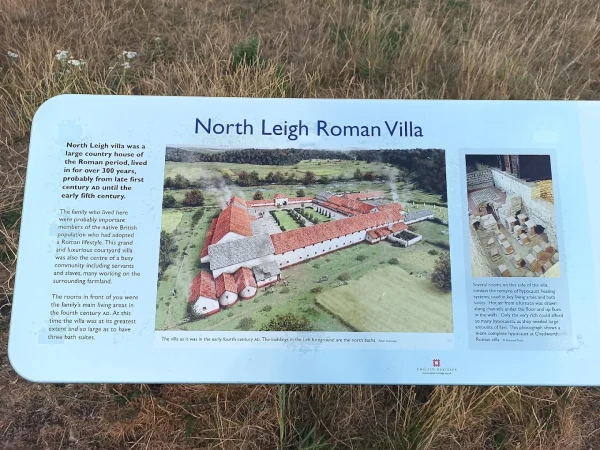
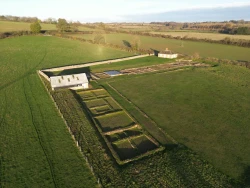
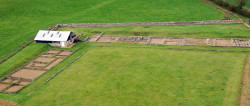
North Leigh Roman Villa The remains of North Leigh Roman Villa are set within a peaceful landscape on the banks of the river Evenlode in Oxfordshire. This ‘courtyard villa’ is considered to be one of the larger villas of Roman Britain. It was at its most extensive in the early 4th century, when it included three bath suites, at least 19 mosaic floors and 11 rooms with underfloor heating.

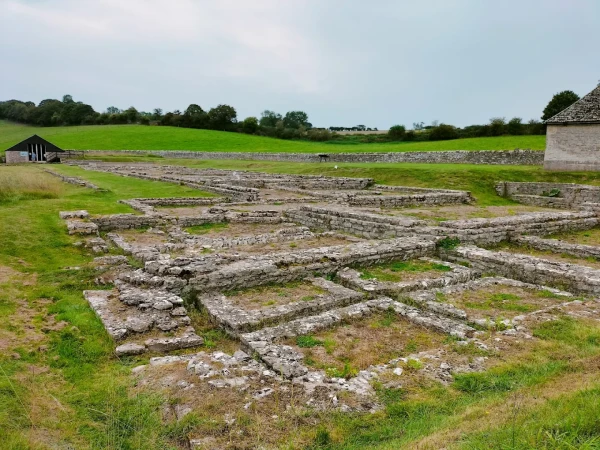
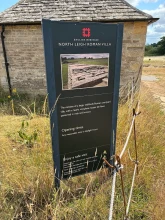
Today, two ranges of the former courtyard arrangement of the villa are visible. The most important feature of the site is a fine mosaic tile floor dating to the early 4th century. Please note that the mosaic is currently covered in protective sheeting and viewable only on special open days when the Mosaic House is opened by our wonderful team of volunteers.  

Free Entry. If you are looking for Best place for day out with kids and families then this is the perfect destination offering fun, adventure, and unforgettable memories for everyone.

Features

  • Free
  • Host birthday parties: No

Features

  • History of North Leigh Roman Villa: The sumptuous Roman villa near North Leigh probably stood at the heart of a large agricultural estate. It seems to have had modest origins in the early 2nd century AD, but grew into a large complex, flourishing into the mid 4th century. At its greatest extent, the villa comprised a luxurious house of four ranges around a courtyard together with further buildings to the south, forming one of the largest known villas in Roman Britain.
  • The remains visible today give an insight into the sophisticated lifestyle enjoyed by the Romano-British elite. They include a fine geometric mosaic that adorned the floor of a dining and reception suite.
  • Roman villas: Villas were houses in the countryside, usually associated with agricultural holdings or estates. They ranged from modest structures to huge complexes, but usually incorporated one or more features that were distinctly Roman in origin, notably underfloor heating, bath-houses, concrete floors, mosaic pavements, and plastered and painted walls. Rooms were clearly separated for different purposes – cooking, dining, bathing, working and sleeping. The agricultural functions of villas were often fulfilled in separate but clearly associated buildings.
  • North Leigh in Roman Britain: The villa at North Leigh is in the valley of the river Evenlode, about 850 metres south of Akeman Street, a major east–west Roman road linking the important provincial towns of Verulamium (St Albans, Hertfordshire) in the east and Corinium (Cirencester, Gloucestershire) in the west. The villa probably fell within the administrative orbit of Corinium, the tribal capital of the Dobunni people.
  • The first villa: The villa developed over 300 years. Archaeologists have identified five broad phases of construction, although the exact dating and details of each phase are unclear.
  • The first rebuilding: This villa, including the baths, was partially demolished, probably in the 3rd century. It was replaced with new buildings, particularly a new main range built on the same alignment and using some of the old foundations. This comprised a set of rooms fronted to the east by a continuous veranda, which served as a corridor. The two wings were extended, also with corridors.
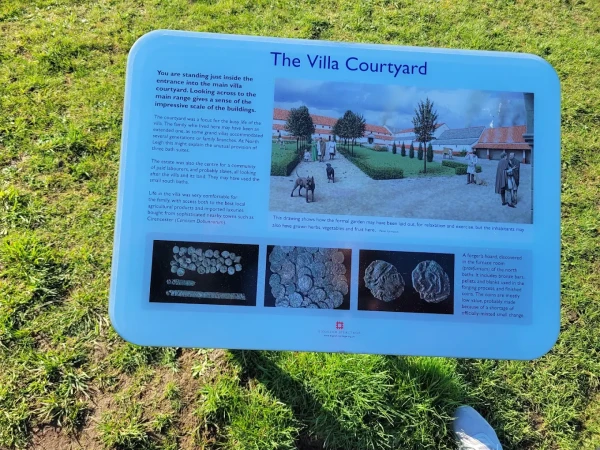
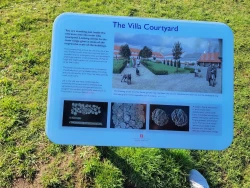
  • The courtyard villa: The villa was greatly expanded, beginning in the late 3rd or early 4th century, to create a huge building around a courtyard. The pre-existing villa formed its north-west range and the short wings were extended to form long north-east and south-west ranges, which were joined by a further range on the south-east side. This closed off an area to create a large central courtyard, which may have included a garden.
  • The mosaics: The villa has produced evidence for at least 19 mosaic floors, though only one remains visible today. Some were elaborate and others plainer, and most had geometric designs. The oldest was laid in a room of the north-west range sometime in the 2nd century AD. Its style is like that of mosaics associated with craftsmen operating from the Colchester and St Albans areas.
  • Later changes and other buildings: Various modifications were made during the life of the courtyard villa. Notably, in the north bath-house, some rooms went out of use and others were added in the mid 4th century. In one of the disused rooms, a hoard of counterfeit coins and materials used for making them had been dumped or concealed, possibly in a bag – fabric fibres were found attached to one of the coins. The coins are of the mid 4th century, making it possible to date the hoard and the changes in the bath-house.
  • Decline: People were still using the villa in the late 4th and early 5th centuries, at the end of the Roman administration of Britain, but they seem to have been of lower status than those who had lived there earlier. The building of rough walls across mosaic floors, and hearths made on them, suggest that the use of the villa was utilitarian. Very coarse, shelly pottery was in use, and in one room a large amount of animal bone, probably from a midden (a rubbish dump), was deposited.
  • Discovery of the villa: The villa was first recorded in 1783 by Thomas Warton as ‘a spreading tumulus, consisting of rubbish and fragments of Roman bricks and cement’. It was extensively excavated between 1813 and 1817 by Henry Hakewill.

Facilities

  • Parking: There is parking space for several cars in a lay-by on the roadside, directly opposite the farm track down to the villa. There is a walk of approximately 0.5km down a farm track to the site entrance. We advise not leaving valuables in vehicles. 
  • Food & Drinks: There are no facilities onsite. The market town of Woodstock is located approximately 10km away where there are public toilets and plenty of places to eat and shop.
  • Dogs: Dogs on leads are welcome to the site. Unfortunately on open days dogs will not be permitted in the Mosaic House. 

Price

Price: Free

Birthday Parties

Offer Birthday Parties: No

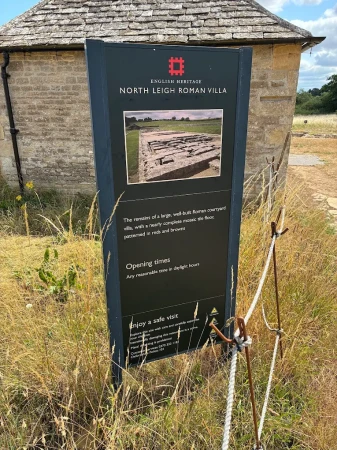
Open any reasonable time during daylight hours.

Address: North Leigh Roman Villa, A4095, North Leigh, Witney, Oxfordshire OX29 6PZ, UK

Post Code: OX29 6PZ

Council: West Oxfordshire

County: Oxfordshire

  • Road Access: 2 miles north of North Leigh; 10 miles west of Oxford, off A4095.
  • Bus Access: Stagecoach route S7 in Oxford city centre to within 2 miles of the Villa.
  • Train Access: Hanborough 3 1⁄2 miles.
  • Bicycle Access: Find this site on The National Cycle Network.
  • Parking: There is parking space for several cars in a lay-by on the roadside, directly opposite the farm track down to the villa. There is a walk of approximately 0.5km down a farm track to the site entrance. We advise not leaving valuables in vehicles. 

0

0 Reviews

Rating breakdown

5
80% Complete (danger)
0
4
80% Complete (danger)
0
3
80% Complete (danger)
0
2
80% Complete (danger)
0
1
80% Complete (danger)
0

More Day Outs in West Oxfordshire

Get the best blog stories into your inbox!