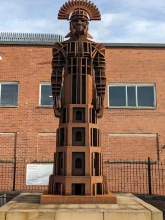
St Paul's Monastery, Jarrow

Description

St Paul's Monastery, Jarrow the monastery at Jarrow was one of Europe's most influential centres of learning and culture in the 7th century. The remains standing today are from the medieval monastery, but part of the Anglo-Saxon monastery survives today as the chancel of St Paul's Church.

Wearmouth–Jarrow was the creation of Northumbrian nobleman Benedict Biscop (about 628–90), who visited Rome and was inspired by the Christian life he saw there. In 674 he approached King Ecgfrith of Northumbria for land for a monastery. He was first given a large estate to found St Peter’s, Wearmouth, and then in 681 received land at Jarrow to found St Paul’s. The twin monastery probably once owned much of the land between the rivers Tyne and Wear. 

Free Entry. If you are looking for Best place for day out with kids and families then this is the perfect destination offering fun, adventure, and unforgettable memories for everyone.

Features

  • Free
  • Host birthday parties: No

Features

  • History of St Paul’s Monastery, Jarrow: St Paul’s Monastery, with its twin, St Peter’s at Wearmouth, Sunderland, was one of Europe’s most influential centres of learning and culture in the 7th and 8th centuries. The remains standing today are from the medieval monastery, re-established in the 11th century. Part of the Anglo-Saxon monastery survives today, however, as the chancel of St Paul’s Church.
  • The Anglo-Saxon Monastery: Wearmouth–Jarrow was the creation of Northumbrian nobleman Benedict Biscop (about 628–90), who visited Rome and was inspired by the Christian life he saw there.
  • In 674 he approached King Ecgfrith of Northumbria for land for a monastery. He was first given a large estate to found St Peter’s, Wearmouth, and then in 681 received land at Jarrow to found St Paul’s. The twin monastery probably once owned much of the land between the rivers Tyne and Wear.
  • Biscop brought stonemasons and glaziers from France, who created some of the first stone buildings in Northumbria since the Roman period. Excavations have revealed that the earliest monastery had two churches, lying parallel to two large buildings, with a guesthouse close to the river.
  • It was not uncommon for Anglo-Saxon monasteries to have more than one church. The larger one may have served local people as well as the monks. The smaller church was perhaps reserved exclusively for monks, or may have been used as a funerary chapel.
  • Of the two other large buildings, one had settings in the floor that might have supported seating. Food debris such as fish bones was also found, suggesting that this was a refectory.
  • The other building contained a large, finely decorated room, probably used as a communal hall. In it was a central stone seat from which the abbot may have presided over meetings of the monks. Each building may have had an upper floor containing dormitories.
  • At the far left of this building was a suite of two rooms divided by a low screen. The finer room was perhaps an oratory, with an altar, and the other a living room.
  • The guesthouse by the riverside was finely decorated with painted plaster and coloured glass windows. Craft and industrial activity (such as metal- and glass-working) also took place on the riverside. There is evidence for terraced gardens on the south-facing slope towards the river, where vegetables and herbs were likely to have been grown.
  • The Venerable Bede: The monastery’s reputation spread throughout Europe, chiefly because of the scholarly writings of the Venerable Bede. Bede entered St Peter’s in about 680 at the age of seven, and spent his life in the twin monastery of Wearmouth–Jarrow, which he described as ‘one monastery in two places’.
  • Inspired by the scholarship and new style of monastic life here, he dedicated his life to study. He wrote more than 60 works, most notably the first history of the English, the Ecclesiastical History of the English People. He died in 735.
  • The Medieval Monastery: During the 9th century monastic life here declined, although the site may have remained a place of pilgrimage because of its association with Bede. In the 1020s some bones, thought to be Bede’s remains, were taken from here to Durham Cathedral.
  • After the Suppression: After the priory was suppressed in 1537, the eastern part of the church remained in use as the parish church. The larger church was demolished and replaced in the 18th century, and was then rebuilt by George Gilbert Scott in the 1860s.

Facilities

Parking: Car parking is available at the site. The monastery can be found behind the church.

Price

Price: Free

Birthday Parties

Offer Birthday Parties: No

The ruins are open any reasonable time during daylight hours.

Address: Church Bank, Jarrow, Tyne and Wear NE32 3DY, UK

Post Code: NE32 3DY

Council: South Tyneside

County: Tyne and Wear

  • Road Access: In Jarrow, on minor road north of A185; follow signs for Bede’s World.
  • Bus Access: Go North East The Crusader services 27.
  • Bicycle Access: Find this site on The National Cycle Network.
  • Parking: Car parking is available at the site. The monastery can be found behind the church.

0

0 Reviews

Rating breakdown

5
80% Complete (danger)
0
4
80% Complete (danger)
0
3
80% Complete (danger)
0
2
80% Complete (danger)
0
1
80% Complete (danger)
0

Get the best blog stories into your inbox!